
Inside Pallas Intel Agency: An Organizational Profile
Named for Pallas Athena, the Greek goddess associated with wisdom and strategic warfare, Pallas Intel Agency represents a category of firm that has grown substantially in both scale and public visibility over the past two decades: the private intelligence and risk advisory company. Where intelligence gathering was once understood almost exclusively as the domain of government agencies, a growing ecosystem of private firms now performs closely related work for corporate clients, law firms, investors, and other private-sector organizations navigating an increasingly complex global risk environment. Examining how a firm like Pallas is typically structured and how it operates offers a useful window into this often misunderstood industry.
Origins of the Private Intelligence Model
The modern private intelligence industry traces much of its lineage to the corporate investigations and executive protection firms that emerged in the twentieth century, but it expanded considerably following the end of the Cold War, as experienced government intelligence, military, and law enforcement professionals increasingly moved into the private sector, bringing specialized analytical skills and professional networks with them. This migration accelerated further after the September 11 attacks, as heightened corporate security spending and a growing emphasis on geopolitical risk management created substantial new demand for the kind of structured analytical work these professionals were trained to provide.
A firm like Pallas typically positions itself in this lineage, built around a leadership team with backgrounds spanning government intelligence services, military intelligence, law enforcement, and financial crime investigation, combined with analysts and researchers trained in open-source research, data analysis, and regional or sector-specific expertise. This blend of experienced leadership and specialized analytical staff is a common structural pattern across the industry, reflecting the reality that private intelligence work draws on a combination of judgment developed through years of professional experience and rigorous, disciplined research methodology.
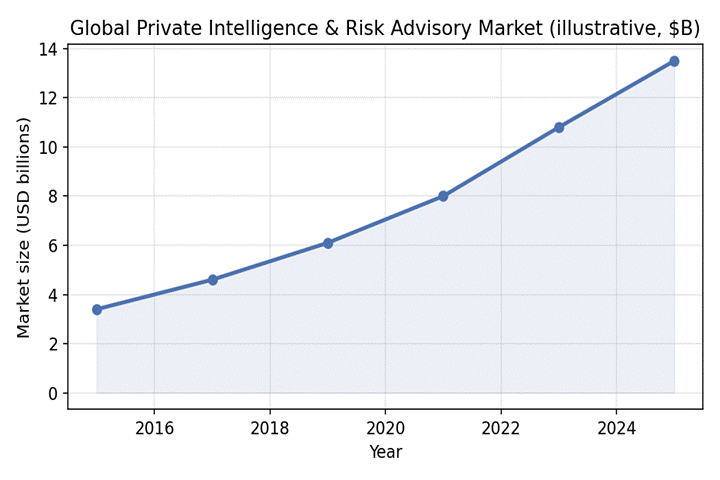
Figure 1: Illustrative growth of the global private intelligence and risk advisory market.
Organizational Structure
Firms in this space are typically organized around a mix of functional and regional expertise. A geopolitical risk division might track political, economic, and security developments across specific regions for clients with international operations or investments, while a corporate intelligence or due diligence division focuses on researching potential business partners, acquisition targets, or counterparties for clients conducting significant transactions. Larger firms often maintain dedicated cyber threat intelligence teams, tracking the tactics and infrastructure used by cybercriminal groups and state-linked hacking operations relevant to client industries, alongside more traditional investigative units handling matters such as fraud investigations, asset tracing, or background research on individuals in the context of litigation or major business decisions.
Unlike government intelligence agencies, private firms generally operate without any legal authority to compel disclosure of information, conduct surveillance beyond what is legally available to any private citizen, or access classified government information. This is a critical, defining distinction: legitimate private intelligence work relies entirely on lawfully accessible sources, including public records, published data, licensed commercial databases, and information gathered through direct, transparent inquiry, rather than the covert collection methods associated with government intelligence services.
Client Relationships and Confidentiality
Given the sensitive nature of the work, client confidentiality is a foundational element of how firms like Pallas typically operate, often formalized through strict non-disclosure agreements and internal information security protocols governing how client engagements and findings are handled. Many firms also maintain careful ethical walls between engagements to avoid conflicts of interest, particularly when working across competing clients within the same industry, a practice similar to conflict management protocols used by law firms and financial advisory firms handling similarly sensitive client information.
A Growing, Professionalizing Industry
The private intelligence industry has grown considerably more professionalized over the past decade, with a growing number of practitioner associations, industry certifications, and academic programs focused specifically on open-source intelligence and corporate risk analysis. This professionalization reflects both growing client demand for rigorous, defensible analytical work and a broader effort within the industry to distinguish legitimate, ethically conducted intelligence and investigative work from the more sensationalized, and occasionally unlawful, practices sometimes associated with corporate espionage scandals that have drawn negative public attention to the sector over the years. Firms that succeed in this environment, including the type of organization Pallas represents, generally do so by building a reputation for rigorous, well-sourced analysis delivered within clear legal and ethical boundaries, recognizing that credibility, once damaged by an ethical lapse, is exceptionally difficult for a firm in this trust-dependent industry to rebuild.
Staffing and Career Paths
The staffing model at a firm like Pallas typically reflects a deliberate blend of seniority and specialization. Senior leadership and practice heads often carry decades of relevant government, military, or law enforcement experience, lending credibility and judgment to client-facing relationships and the most sensitive engagements. Beneath that senior layer, firms typically build out teams of research analysts, many drawn from academic backgrounds in area studies, political science, data analysis, or investigative journalism, who bring the research discipline and language or regional expertise needed for day-to-day collection and analysis work. This combination allows a firm to pair experienced judgment with the sustained analytical capacity needed to service a broad and growing client base.
Career paths within this industry have also become more structured as the sector has matured, with many firms now offering formal analyst training programs, rotational assignments across different service lines, and increasingly clear promotion tracks from junior researcher through senior analyst and eventually practice leadership roles, a level of organizational formality that stands in contrast to the industry’s more informal, network-driven origins several decades ago.
Global Footprint and Local Presence
Because much of the value a firm like Pallas provides depends on genuine regional and sector expertise rather than generic research capability, firms of meaningful scale typically maintain offices or dedicated regional teams across multiple continents, allowing them to draw on staff with native language skills, direct familiarity with local regulatory and business environments, and, in many cases, personal professional networks built over years of prior government or private-sector experience in that specific region. This global footprint distinguishes larger, more established firms from smaller boutiques that may excel within a narrower geographic or sectoral specialization but lack the breadth to service clients with genuinely global operations and risk exposure spanning many different regions simultaneously.