
Industries and Clients: Who Hires a Private Intel Firm
The client base for a firm like Pallas Intel Agency spans a wide range of industries, reflecting how broadly the need for rigorous risk analysis and due diligence has spread across the modern corporate landscape. Examining the kinds of organizations that typically engage private intelligence firms, and why, offers useful insight into how central this kind of analytical work has become to decision-making well beyond its traditional government intelligence origins.
Financial Services and Investors
Financial institutions, including banks, private equity firms, hedge funds, and institutional investors, represent one of the largest client categories for private intelligence firms, driven by a combination of regulatory compliance requirements and genuine investment risk management needs. Before completing a major investment or acquisition, financial firms routinely commission due diligence research on target companies and their leadership, while ongoing compliance obligations, particularly anti-money laundering and sanctions screening requirements, create sustained demand for background research on business counterparties and, in some cases, ongoing monitoring of higher-risk relationships over time.
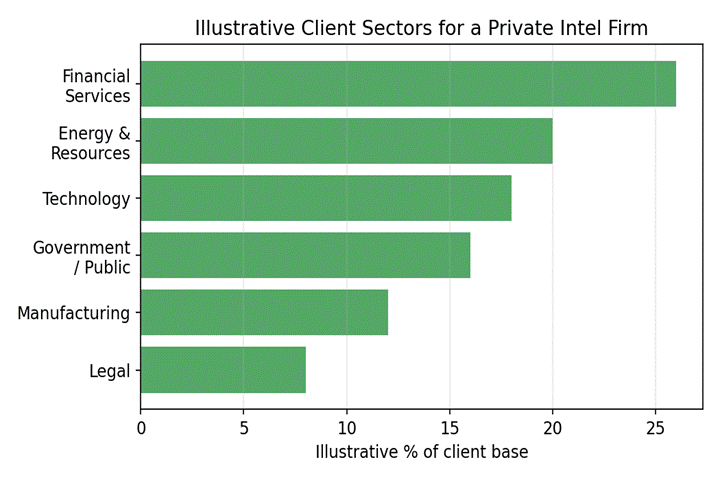
Figure 4: An illustrative breakdown of client sectors typical of a private intelligence and risk advisory firm.
Energy, Resources, and Infrastructure
Companies operating in energy, mining, and large infrastructure projects frequently engage private intelligence firms given the significant political, security, and regulatory risks often associated with major projects in this sector, particularly those located in regions with less stable governance or higher security risk. Geopolitical risk analysis, community and stakeholder mapping, and security threat assessments are common engagement types for this client category, reflecting the genuinely elevated operational risks these companies face compared to businesses operating primarily within stable, well-established markets.
Technology Companies
Technology firms represent a growing client category, driven substantially by cybersecurity concerns, including both cyber threat intelligence services aimed at understanding and anticipating attacks against their own systems, and intellectual property protection work aimed at investigating potential theft of trade secrets or unauthorized use of proprietary technology by competitors. Technology companies expanding into new international markets also frequently commission the kind of geopolitical and regulatory risk research more traditionally associated with industries like energy and manufacturing, reflecting the increasingly global operating footprint of even relatively young technology companies.
Legal and Professional Services Firms
Law firms represent a distinctive and significant client category, frequently engaging private intelligence firms to support litigation, including asset tracing to identify recoverable assets in judgment enforcement matters, background investigations relevant to a legal dispute, and due diligence support for clients involved in complex corporate transactions. This work requires particularly careful attention to legal and ethical boundaries, since evidence gathered inappropriately, or through methods that raise legal concerns, can potentially be excluded from legal proceedings or expose both the investigating firm and its law firm client to liability, making the credibility and methodological rigor of a private intelligence firm especially important to legal sector clients.
Government and Public Sector Clients
While private intelligence firms are, by definition, separate from government intelligence agencies, government bodies themselves are sometimes clients of private firms, particularly for specialized research capabilities or surge capacity that government agencies may lack internally, or for work that specifically requires the kind of open-source, unclassified research methodology private firms specialize in, as distinct from classified intelligence work that remains the exclusive domain of government agencies. This client relationship generally involves considerable additional scrutiny and formal procurement processes compared to private-sector engagements, reflecting the particular sensitivities involved in government contracting more broadly.
A Common Thread Across Client Types
Despite the diversity of industries private intelligence firms serve, the underlying client need is generally consistent: organizations facing consequential decisions under conditions of incomplete information, whether that decision involves a major acquisition, an expansion into an unfamiliar market, or managing an emerging security or reputational threat, seeking rigorous, independent analysis to help inform that decision. This common thread, more than any specific industry specialization, is what ultimately defines the value proposition a firm like Pallas offers across its varied client base.
Nonprofit, Academic, and Media Clients
Beyond the corporate and legal clients that make up the bulk of most private intelligence firms’ revenue, a smaller but notable client category includes nonprofit organizations, academic institutions, and media organizations, particularly investigative journalism outlets, seeking specialized research support for projects requiring skills similar to those used in corporate due diligence, such as tracing complex corporate ownership structures or verifying claims made by a subject of investigation. Human rights organizations and journalists have increasingly drawn on open-source intelligence methodology, sometimes contracting directly with specialized firms and sometimes simply adopting similar research techniques internally, to document and verify claims in conflict zones or other environments where traditional on-the-ground reporting is difficult or dangerous to conduct directly.
This cross-pollination between the private intelligence industry and investigative journalism has grown notably over the past decade, with several well-known open-source investigation methodologies originating in a blend of journalistic and private-sector analytical practice, reflecting how portable the underlying research discipline has proven to be across what might otherwise seem like quite different professional fields and client needs.
Repeat Engagements and Long-Term Relationships
Across nearly all of these client categories, the most valuable relationships for a firm like Pallas tend to be long-term rather than one-off, since a client that returns repeatedly for new engagements allows a firm to build deeper institutional familiarity with that client’s business, risk tolerance, and decision-making style, generally producing more efficient and more precisely tailored analysis over time than a firm could offer a first-time client working from a standing start. Many firms explicitly structure their business development efforts around cultivating this kind of ongoing relationship, viewing a satisfied client’s likelihood of returning for future engagements, and of referring the firm to peer organizations facing similar risk challenges, as a more reliable long-term growth strategy than continually pursuing new, unfamiliar client relationships from scratch. This relationship-driven growth model also means that reputation and word-of-mouth referral within tightly networked professional communities, such as general counsel offices or corporate risk committees, often matter more to a firm’s long-term success than conventional marketing or advertising, reinforcing why maintaining consistent quality and trust across every engagement remains so central to how firms in this industry sustain their business over time.